Few knives carry as much history as the Bowie knife. It has been a frontier tool, a dueling weapon, a military companion, and a cultural icon — all wrapped into one recognizable blade. Whether you collect knives, carry one for outdoor use, or simply want to understand where this design came from, knowing the Bowie knife history gives you a real appreciation for why it still matters today.
This article walks you through the full story — from a bloody sandbar duel in 1827 to the modern blades you can find on shelves right now.
What Exactly Is a Bowie Knife?
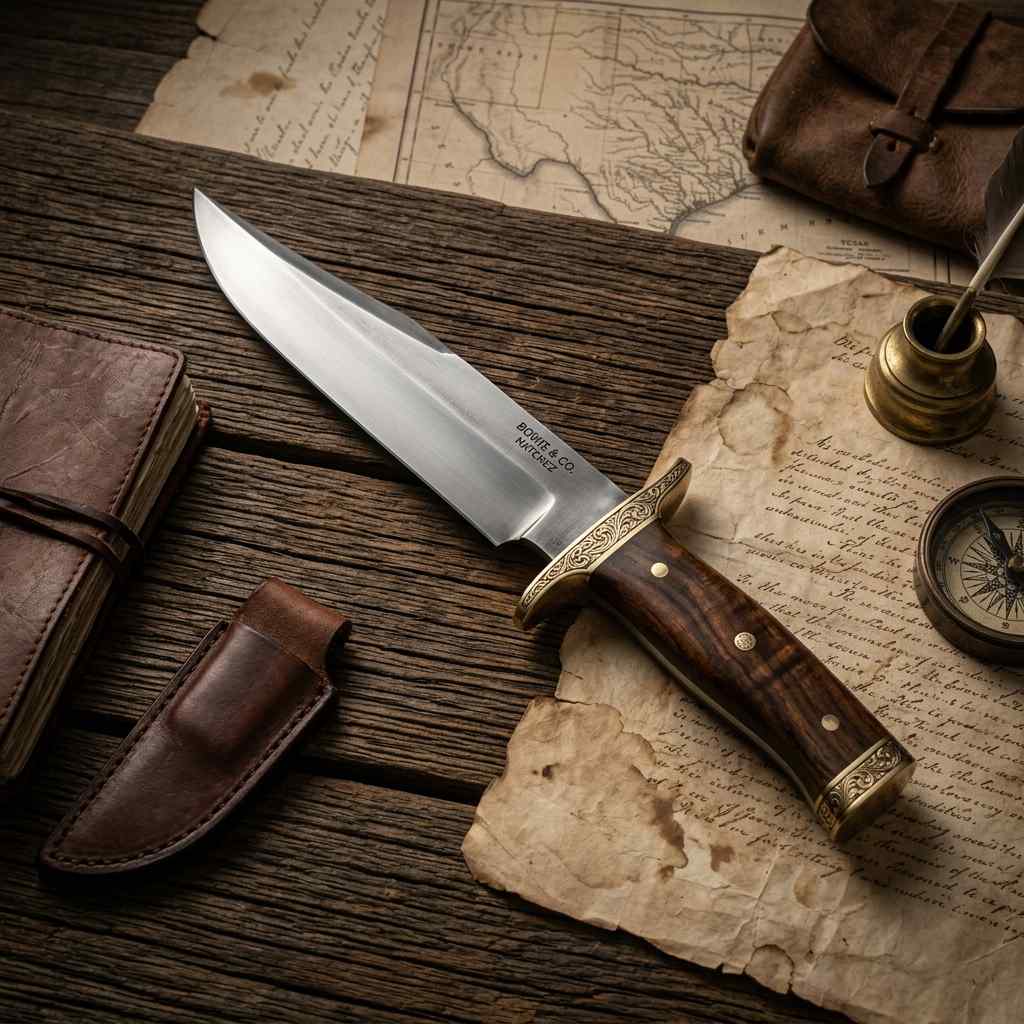
Before diving into history, it helps to understand what sets this knife apart. The Bowie knife is typically a large fixed-blade knife with a clip point, a crossguard to protect the hand, and a blade long enough for serious work — usually between 6 and 12 inches. It was designed to handle tasks that smaller knives simply couldn’t.
If you want a detailed breakdown of the design, materials, and defining features, check out this guide on what a Bowie knife is — it covers everything from blade geometry to handle construction.
The core design has stayed remarkably consistent for nearly 200 years, which says a lot about how well the original concept worked.
The Origins: A Sandbar, a Fight, and a Legend
The Bowie knife’s story starts not in a blacksmith’s workshop, but in a field of blood.
On September 19, 1827, a duel took place on a sandbar in the Mississippi River near Natchez, Louisiana. What began as a formal duel between two other men quickly erupted into a full-scale brawl involving several parties. James Bowie — a land speculator, slave trader, and frontiersman from Louisiana — was shot, stabbed, and still managed to kill one man and wound others with a large knife he carried.
The story spread fast. Newspapers covered it widely, and “the Bowie knife” became a household name almost overnight. People wanted the same blade. Knife makers across the country started producing their own versions, often calling them Bowie knives regardless of whether they matched the original.
That’s actually a key part of the Bowie knife history: no single original design exists. The legend was bigger than any one knife.
Jim Bowie: The Man Behind the Myth
James “Jim” Bowie was born around 1796 in Kentucky and raised in Louisiana. He was many things — ambitious, financially reckless, violent when necessary, and genuinely skilled on the frontier. By the time he became famous for his knife, he had already built and lost fortunes in land deals and reportedly smuggled enslaved people with the pirate Jean Lafitte.
Bowie moved to Texas in the early 1830s, at a time when the region was still under Mexican rule and tensions were rising. He married into a prominent Mexican-Texan family, learned Spanish, became a Mexican citizen, and threw himself into Texas politics and conflict.
His death at the Battle of the Alamo on March 6, 1836, cemented his place in American mythology. He reportedly died in his cot, too ill to stand, but accounts of the battle gave him a heroic end. True or not, the story stuck.
Jim Bowie never became famous for statesmanship or business success. He became famous for a knife and how he used it — and that knife outlasted him by centuries.
Who Actually Made the First Bowie Knife?
This question has fueled debate for a long time, and the honest answer is: we’re not entirely sure.
The two most commonly credited makers are James Black, a blacksmith from Washington, Arkansas, and Jesse Cliff, a craftsman from Louisiana. Some accounts suggest Jim’s brother Rezin Bowie designed the original knife and had it made before the famous sandbar fight. Others claim Jim redesigned it after surviving that brawl, wanting something better.
James Black is the more romanticized choice — legends claim he used a lost Damascus steel technique and made a blade of extraordinary quality. However, historical documentation for these claims is thin, and many knife historians remain skeptical.
What’s clear is that the Bowie knife became a commercial product almost immediately after the sandbar fight. Sheffield, England — then the world’s center of knife manufacturing — began exporting Bowie knives to America in large numbers by the 1830s. American blacksmiths followed. The design was never patented, so everyone made their own version.
How the Design Evolved Over Nearly 200 Years
The original Bowie knife, whatever it looked like, inspired hundreds of variations. Over the decades, the design shifted based on who was carrying it and what they needed.
The Antebellum Period (1830s–1860s)
In the American South and Southwest, large Bowie-style knives became common sidearms. They were personal defense weapons, hunting tools, and status symbols. Sheffield makers exported millions of them. Blade lengths ranged wildly, from 6 inches to over 12 inches, and handle materials ran from simple wood to ornate ivory and silver.
The Civil War Era
Both Union and Confederate soldiers carried Bowie knives into battle, especially early in the war when enthusiasm ran high. As the conflict dragged on, soldiers learned that a heavy knife had practical limits in sustained warfare. Many were discarded or sent home. Still, the Bowie remained part of military culture.
The Late 1800s and the Closing Frontier
As westward expansion brought law and order to the frontier, carrying large fighting knives became less common in daily life. The Bowie knife transitioned more toward hunting, camping, and utility use. It remained a staple for hunters, trappers, and outdoorsmen.
The 20th Century
Two world wars refreshed interest in combat knives. The famous Ka-Bar fighting knife used by the U.S. Marine Corps draws a clear line from Bowie knife tradition. Meanwhile, the civilian market kept producing Bowie-style blades for collectors and outdoors enthusiasts.
Today
Modern Bowie knives are made with high-performance steels, ergonomic handles, and precision grinds that would impress any 19th-century blacksmith. The fundamental shape — clip point, guard, substantial blade — remains immediately recognizable.
What Were Bowie Knives Actually Used For?
The Bowie knife’s reputation as a fighting weapon tends to overshadow its genuine utility. In practical terms, the knife was a do-everything tool for people living and working in rough conditions.
- Hunting and field dressing: The blade length and clip point made it effective for large game.
- Camp and trail work: Chopping, splitting kindling, building shelter — tasks that required a heavy, reliable blade.
- Self-defense: On the frontier, where law enforcement was sparse, people relied on their own tools for protection.
- Military applications: From the Civil War to special operations use in the 20th century, military personnel found the Bowie profile useful.
This combination of utility and lethality is exactly what made the design so durable. It wasn’t one-dimensional. A Bowie knife could do real work during the day and defend a life at night.
Why the History Still Matters When Buying Today
Understanding where the Bowie knife came from helps you make better choices as a buyer. The design wasn’t created in a marketing room — it was forged through real-world use by people whose lives depended on their tools. Every feature has a reason behind it.
The clip point isn’t just aesthetic — it reduces tip weight for better control. The crossguard isn’t decorative — it stops a hand from sliding onto the blade. The blade length isn’t arbitrary — it reflects a balance between reach, leverage, and portability.
When you shop for a Bowie knife today, you’re choosing from a lineage nearly two centuries deep. The best modern versions respect that tradition while taking advantage of steel technology and manufacturing precision that Jim Bowie never had access to.
If you’re ready to explore current options, browse the Bowie knife collection at Sami Blades — the range covers everything from classic hunting designs to more tactical builds, all rooted in the same proven pattern.
Conclusion
The Bowie knife history is, in many ways, a slice of American history. It started with a violent moment on a sandbar, spread through newspapers and word of mouth, crossed an ocean to Sheffield and back, survived two world wars, and arrived in the 21st century as relevant as ever.
That kind of staying power doesn’t happen by accident. The design earned its reputation through genuine performance across real conditions. And while the legends around Jim Bowie are a mix of fact and folklore, the knife itself is the real deal — a tool that has consistently delivered across nearly 200 years of use.
If you carry one, collect one, or simply respect good craftsmanship, the Bowie knife deserves that respect. It got here the hard way.